
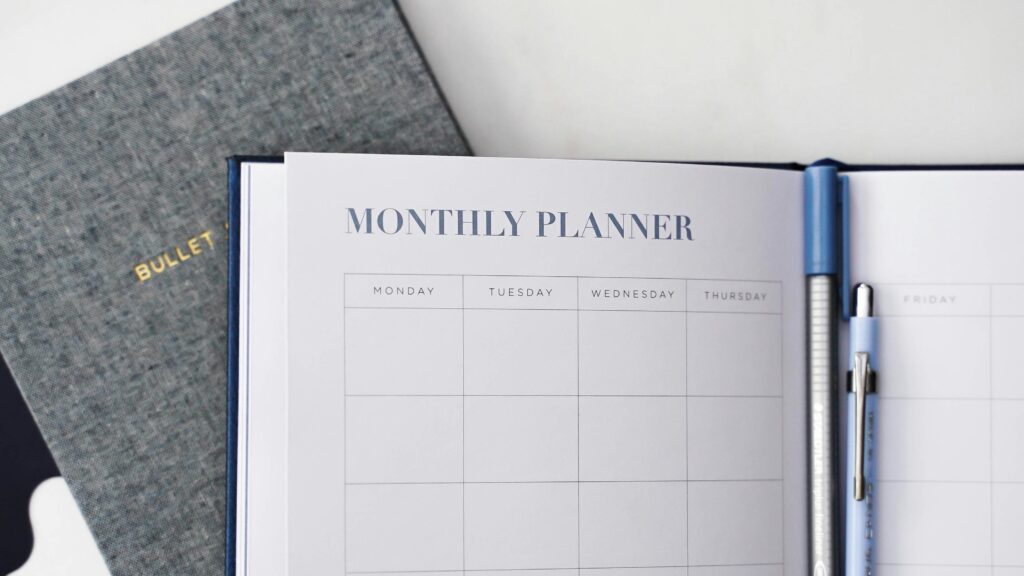
Start with Your Non Negotiables
Before you start adding color coded goals and Pinterest worthy plans to your week, stop and look at what’s already on your plate. Block off the non negotiables first: school drop offs and pick ups, work hours, mealtimes, bedtime routines. These aren’t optional, and trying to build a planner without them in place is like building a house without a foundation.
These are your anchors. They ground your day and define your available bandwidth. Once they’re in, you’ll suddenly see how much space you actually have and more importantly, how much you don’t. It’s easy to overcommit when your week looks like a blank canvas. But a working mom’s week is more like a game of Tetris: you don’t get extra hours, just better placement.
Be honest about your time. Life already throws curveballs don’t set yourself up to drop the ball by pretending Tuesday afternoon is wide open when it’s really just two hours between meetings and school pickup. Protect your time by recognizing what’s fixed, and build the rest around that.
Theme Your Days for Simplicity
One of the quickest ways to cut decision fatigue is to give each day a purpose. You don’t need to overthink it just assign a basic focus to each day of the week. Think “Laundry Tuesday,” “Errand Wednesday,” or “Catch Up Friday.” These themes act like mental shortcuts. When you wake up, you already know what’s on deck.
Having structured days doesn’t mean locking yourself into a rigid schedule. Life with kids changes fast. The goal isn’t perfection it’s rhythm. When you know Monday is for meal prep, you’re not scrambling last minute. When Thursday is your admin day, small tasks don’t pile into chaos.
Themes simplify choices, reduce the number of tabs open in your head, and let you batch your energy more effectively. Even loose themes make a big difference you’ll be surprised how much smoother the week feels just by giving each day a name.
Use Time Blocks, Not To Do Lists
Trying to power through a long to do list as a mom? It’s one way express shipping to burnout. Instead, split your day into three manageable blocks: morning, afternoon, and evening. Don’t overthink it these blocks help you work with your energy levels, not against them.
In each block, aim to tackle just 1 to 3 focused tasks. That’s it. Trying to do more usually means getting less done, and with a lot more stress. Whether it’s grocery shopping, helping with homework, or catching up on work emails, pick your top few priorities and let the rest sit until the next window.
Equally important: build in the quiet stuff. Buffer time for traffic, downtime between school pickups, or even 20 minutes on the couch counts. And don’t forget to schedule family time like you would any other commitment it’s not extra, it’s core. This kind of simple time block approach turns chaos into clarity.
Your planner shouldn’t add pressure. It’s about making the day work smarter not fuller.
Batch Similar Tasks Together
Start thinking of your tasks like laundry when you run around doing one sock at a time, it just doesn’t make sense. The same goes for your daily to dos. Group errands into one outing. Knock out calls in a single block. Set aside a window for cleaning instead of spreading it out over the entire week. Content creation for social? Pick a day, focus, and film or write in one go.
This method is called “batching,” and it’s a solid strategy for moms juggling dozens of moving parts. It reduces the mental drag of task switching and gives your brain a break. You use less energy, waste less time, and actually get more done. It’s not about multitasking it’s about smart clumping.
Want to dig deeper? Check out Batching Tasks A Game Changer for Busy Moms.
Plan the Week Before It Starts
Waiting until Monday morning to figure out your week? That’s a hard pass. Pick a day Sunday night works for most and set aside 20 30 minutes to map things out. This isn’t about making a perfect schedule; it’s about giving yourself a clear runway so the week doesn’t crash into you at full speed.
Start by plugging in what’s already decided: appointments, school events, family commitments, work hours. Then look at what’s left and intentionally carve out personal time yes, that includes breaks, solo errands, or a quiet cup of coffee that doesn’t involve hiding in the pantry.
Not a paper person? No problem. Use your phone. Prefer colors? Break out the markers or planner stickers. Visual tools aren’t just cute they help your brain process the week faster. Use what actually works for you, not what looks Instagram worthy.
Planning ahead isn’t about control. It’s about breathing room. Give yourself that space.
Keep It Visible and Real
The best planner is the one you’ll actually use. That might mean a big paper wall calendar in the kitchen, a magnetic whiteboard on the fridge, or a synced digital calendar on your phone. Fancy systems don’t matter if they stay closed. Pick something you see often and can update easily.
If you’ve got older kids, bring them into the loop. Let them help write in soccer games, birthday parties, or school projects. It teaches them responsibility and keeps you from being the only one managing the family calendar.
And give yourself grace. Life throws curveballs. A sick kid, traffic jam, or spontaneous meltdown will shift a perfect plan. Build in space for that. A week that flexes is better than one that crashes. Adjust, move things around, and most importantly don’t guilt yourself over it.
Revisit and Adjust Weekly
A planner that just sits there collecting dust isn’t helping anyone. Set aside a few minutes each week to review what actually worked. Maybe Monday’s time blocks held strong, but Wednesday crumbled under surprise dentist appointments and toddler meltdowns. That’s normal.
The point is to learn what fits your real life not an ideal version of it. If meal planning keeps getting skipped, maybe it needs its own time block. If after school chaos blows up your afternoons, build in buffer time. Don’t throw out the whole plan refine it.
Think of your planner as something flexible, not carved in stone. Life with kids is fluid, unpredictable even chaotic at times. A good planner should shift with you. Tweak it, stretch it, ignore it when you must. Then come back and adjust again.
It’s not a system you obey. It’s a tool you adapt.
Pro Level Tip: Add a “You Block”
If you’re building a weekly planner, put yourself on the schedule. One block a day just 15 minutes is enough. Think a slow cup of coffee, a quiet walk, flipping through a few pages of that book you never finish. Doesn’t have to be monumental. It just has to be yours.
Because here’s the truth: moms don’t burnout from chaos; they burnout from never stopping. You can’t pour from a dry cup, and no planner will save you if it forgets about you. A “You Block” is small, but it’s powerful. It signals that your time matters too.
Creating your own weekly planner is less about perfection and more about clarity. Start small, stay consistent, and make it your own.
 Betty Bolestiers has opinions about family activities and projects. Informed ones, backed by real experience — but opinions nonetheless, and they doesn't try to disguise them as neutral observation. They thinks a lot of what gets written about Family Activities and Projects, Healthy Meal Ideas for Kids, Parenting Tips and Hacks is either too cautious to be useful or too confident to be credible, and they's work tends to sit deliberately in the space between those two failure modes.
Reading Betty's pieces, you get the sense of someone who has thought about this stuff seriously and arrived at actual conclusions — not just collected a range of perspectives and declined to pick one. That can be uncomfortable when they lands on something you disagree with. It's also why the writing is worth engaging with. Betty isn't interested in telling people what they want to hear. They is interested in telling them what they actually thinks, with enough reasoning behind it that you can push back if you want to. That kind of intellectual honesty is rarer than it should be.
What Betty is best at is the moment when a familiar topic reveals something unexpected — when the conventional wisdom turns out to be slightly off, or when a small shift in framing changes everything. They finds those moments consistently, which is why they's work tends to generate real discussion rather than just passive agreement.
Betty Bolestiers has opinions about family activities and projects. Informed ones, backed by real experience — but opinions nonetheless, and they doesn't try to disguise them as neutral observation. They thinks a lot of what gets written about Family Activities and Projects, Healthy Meal Ideas for Kids, Parenting Tips and Hacks is either too cautious to be useful or too confident to be credible, and they's work tends to sit deliberately in the space between those two failure modes.
Reading Betty's pieces, you get the sense of someone who has thought about this stuff seriously and arrived at actual conclusions — not just collected a range of perspectives and declined to pick one. That can be uncomfortable when they lands on something you disagree with. It's also why the writing is worth engaging with. Betty isn't interested in telling people what they want to hear. They is interested in telling them what they actually thinks, with enough reasoning behind it that you can push back if you want to. That kind of intellectual honesty is rarer than it should be.
What Betty is best at is the moment when a familiar topic reveals something unexpected — when the conventional wisdom turns out to be slightly off, or when a small shift in framing changes everything. They finds those moments consistently, which is why they's work tends to generate real discussion rather than just passive agreement.